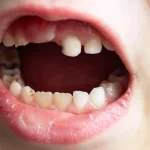

If your child’s baby teeth are not falling out, it is often a normal variation in development. Most children start losing baby teeth around age six, but timing can vary widely. Delays may happen if a child’s dental development is slower, the baby tooth has longer roots, there is crowding, or the permanent tooth underneath is missing. A pediatric dentist can evaluate whether the delay is normal or needs attention.
When Do Baby Teeth Normally Fall Out?
Baby teeth usually begin to loosen and fall out around age six, though it can happen earlier or later.
This process continues gradually into the early teenage years as permanent teeth replace baby teeth.
Some children lose teeth early, while others take more time. Both can be completely normal.
Why Aren’t Your Child’s Baby Teeth Falling Out?
There are several common reasons why baby teeth may stay in longer than expected.
1. Natural Variation in Development
Every child develops at their own pace.
Some children have a “younger” dental age compared to their actual age, meaning their teeth develop more slowly. This often explains delayed tooth loss and is usually not a concern.
2. Root Resorption Is Taking Longer
Baby teeth fall out through a natural process called root resorption.
This means:
- The roots of the baby tooth gradually dissolve
- The tooth becomes loose
- It eventually falls out
If a baby tooth has longer roots, this process can take more time, delaying when the tooth becomes loose.
3. Crowding (Lack of Space in the Jaw)
Crowding occurs when there is not enough space in the jaw for permanent teeth to come in properly.
In these cases:
- The permanent tooth may not push directly under the baby tooth
- The baby tooth may remain in place longer
- Permanent teeth may come in at an angle or behind existing teeth
This can affect the normal timing of tooth loss.
4. Missing Permanent Tooth (Congenitally Missing)
In some children, a permanent tooth may not develop at all. This is called a congenitally missing tooth.
When this happens:
- There is no pressure from a permanent tooth underneath
- The baby tooth does not receive the signal to loosen
- The baby tooth may stay in place much longer than usual
A dental X-ray can confirm whether a permanent tooth is present.
How Do Dentists Check What’s Happening?
If a baby tooth is not falling out, a pediatric dentist may recommend dental X-rays.
X-rays help:
- Determine if a permanent tooth is developing
- Check the position of the permanent tooth
- Evaluate root resorption
- Identify crowding or alignment issues
This allows the dentist to decide whether to monitor or intervene.
When Should You Be Concerned?
Most delays are harmless, but it is worth checking if:
- Baby teeth remain long after others of the same type have fallen out
- Permanent teeth are coming in behind or beside baby teeth
- Teeth appear crowded or misaligned
- There is no sign of loosening over time
- Your child is significantly past the typical age range
A professional evaluation can clarify whether the delay is normal.
What Are the Risks of Ignoring Delayed Tooth Loss?
If the underlying cause is not addressed, it may lead to:
- Misaligned permanent teeth
- Crowding or bite problems
- Teeth erupting in the wrong position
- Delayed dental development
Early evaluation helps guide proper spacing and alignment.
What Can Parents Do at Home?
Parents can support healthy tooth development by:
- Encouraging regular brushing and oral hygiene
- Providing a balanced diet that supports growth
- Avoiding pulling teeth that are not ready
- Monitoring for signs of loosening or discoloration
Let the tooth fall out naturally unless advised otherwise by a dentist.
When Should You See a Pediatric Dentist?
You should schedule a visit if:
- A baby tooth is not loosening as expected
- A permanent tooth is erupting in the wrong position
- You suspect a missing tooth
- There are concerns about crowding or alignment
- You want reassurance about your child’s development
A pediatric dentist can determine whether monitoring or treatment is needed.
Can Baby Teeth Stay Longer Than Expected?
Yes, in some cases, baby teeth can remain longer than usual, especially if there is no permanent tooth underneath.
Depending on the situation, the dentist may:
- Monitor the tooth
- Recommend removal if needed
- Plan for future spacing or alignment
Each case is different, and decisions are based on the child’s development.
A Reassuring Note for Parents
It can feel concerning when your child’s teeth are not falling out on schedule, but in many cases, this is simply a normal variation. Children develop at different rates, and delayed tooth loss is often harmless.
If there is an underlying reason, pediatric dentists can identify it early and guide the next steps. A simple checkup can provide reassurance and help ensure your child’s smile develops properly.